
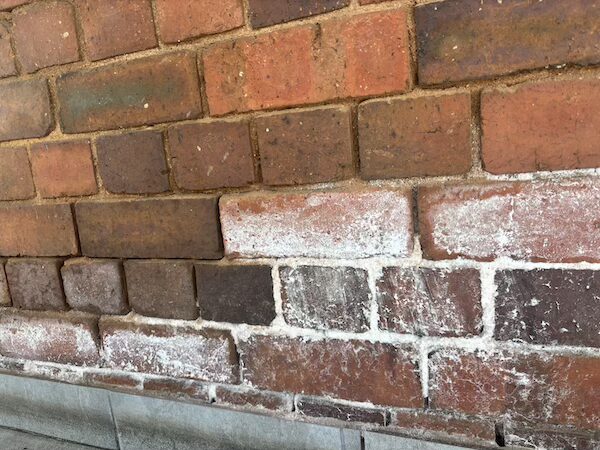
What Efflorescence Means And When To Call In The Professionals
You noticed it on a Saturday morning: a chalky white bloom creeping across the brick near the patio door, or dusted along the base of the boundary wall. It wasn’t there last month. Your first thought might be mould but wipe it, and it doesn’t smear or stain the way mould does. It’s dry and powdery, almost like a thin layer of frost that won’t melt.
That’s efflorescence, and if you’ve just spotted it on your own home, you’re not alone. It’s one of the most common and most misunderstood marks a South African homeowner finds on brick, plaster or concrete.
What Efflorescence Actually Is
Efflorescence is a crystalline salt deposit left behind when water moves through a porous building material — brick, mortar, plaster or concrete — and evaporates at the surface. As the water travels through, it dissolves naturally occurring salts inside the material. When it reaches the surface and evaporates, those salts are left behind as the white, powdery residue you see.
It’s mineral, not organic, which is the easiest way to tell it apart from mould: efflorescence has no musty smell, doesn’t spread in mould’s fuzzy or spotted pattern, and brushes off as a dry powder rather than a damp smear.
On its own, efflorescence usually isn’t a structural problem. But it is a visible symptom of something less visible: moisture is moving through your wall. Whether that’s a one-off, common in newly built homes as construction moisture dries out, or an ongoing issue depends on where it appears and whether it keeps coming back.
What You Can Check Yourself First
A few simple checks can help you work out whether this is a passing nuisance or a sign of something bigger:
- Try a dry brush, not water. Water can dissolve more salts and draw them to the surface, making the deposit worse. A stiff dry brush is the safer first step.
- Note where it’s appearing. Efflorescence low down, near ground level, often points to rising or lateral damp — moisture moving up from the soil. Higher up a wall, it’s more often linked to a leak somewhere above: a gutter, a roof flashing, or a window.
- Check the obvious outdoor causes. Is a downpipe discharging straight against the wall? Is the ground sloping toward the foundation instead of away from it? Are gutters blocked or overflowing in the same spot?
- Watch whether it comes back. If you brush it off and it reappears within a few weeks, that’s a sign the moisture source is ongoing — not a once-off from new plaster or recent construction drying out.
If the deposit is light, isolated, and doesn’t return once you’ve cleared an obvious external cause, it may well resolve on its own. If it keeps returning or shows up alongside other signs, that’s the cue to get it looked at properly.
When It’s Time To Call In The Professionals
Efflorescence is a symptom, not a diagnosis and that’s exactly where a specialist earns their keep. It’s worth calling in a damp specialist when:
- The efflorescence keeps returning after cleaning, even once you’ve ruled out the obvious external causes
- It’s spreading to a larger area, or appearing somewhere new
- You’re also noticing peeling paint, bubbling plaster, a musty smell, or patches that feel damp to the touch
- The affected wall is below ground level or part of a retaining structure, where rising or lateral damp is more likely
- You simply can’t tell whether it’s rising damp, lateral damp, or penetrating damp — each has a different fix, and treating the wrong one wastes time and money
A proper damp inspection identifies exactly where the moisture is coming from and which type of damp you’re dealing with, rather than just treating the white powder itself. That’s the difference between a wall that looks clean for a season and one that actually stops the problem at its source.
Got Efflorescence? Let Dampcon Take A Look
Dampcon® has been solving rising, lateral and penetrating damp for South African homes since 1985. If you’re seeing efflorescence that keeps coming back, our damp specialists can pinpoint the cause and recommend the right fix — backed by our no-nonsense guarantee and insured, five-star service.
Get in touch with our damp specialists or explore our damp specialist services to find out more. Additional information available on our YouTube channel
